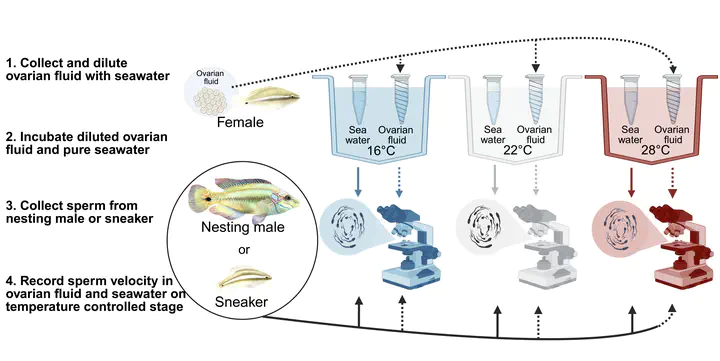
 Fish artwork: Clara Lacy
Abstract
- Understanding the thermal sensitivity of reproductive interactions is crucial given global warming. Previous studies have almost exclusively focused on interactions before mating, even though important interactions between the sexes also occur after mating (e.g., gamete interactions), which are likely also affected by temperature.
2. Thus, it remains unknown how temperature affects the influence of female reproductive fluid on sperm performance, thereby altering female control over fertilization (cryptic female choice). This gap limits our understanding of how sexual selection changes with seasonal temperature fluctuations and temperatures outside the range of historical norms.
3. We tested how temperatures relevant to current conditions and climate change projections influence the mechanisms underlying cryptic female choice in a marine fish, Symphodus ocellatus. Under typical, cooler thermal conditions, female reproductive fluid enhances sperm velocity and biases fertilization dynamics to favor preferred, dominant males over sneaker males.
4. We find that warmer temperatures decrease female influence on sperm velocity, especially for dominant males. This results in dominant males having slower sperm than sneaker males at warmer temperatures, reducing the expected paternity of preferred, dominant males.
5. Our results highlight that considering the thermal sensitivity of female-male interactions that occur after mating will be essential for understanding how seasonal variation and climate change can influence fertility, reproduction, and sexual selection.

Matthew Kustra
Miller Postdoctoral Research Fellow
My research interests include sexual selection, speciation, and endosymbionts.